EPILOGUE
2005 I replaced the OEM rudder with a Booth rudder in 2005. I can tell you that the boat DEFINTELY has better manners under INBOARD power with the new rudder than the old one. With the OEM rudder, the boat used to yaw violently to port under power in forward. It was hard for me to control it -- I'm a petite woman. Now I can control the tiller with ease .
Balance area is generally a good thing under sail, decreasing tug & load on the tiller; but it likely was part of my problem powering in forward. Balance is not your friend when the prop is pushing water at the rudder. The Booth rudder has less "balance area" than the OEM rudder, but it has plenty enough to reduce tiller tug under sail.
BTW, I asked Jim Antrim, N.A., for his advice about which rudder would solve my problem when motoring (Booth vs IdaSailor), and he recommended the Booth rudder for my inboard powered, tiller steered boat. He said either rudder would give me better lift/drag under sail and easier backing than the OEM rudder. I took his advice and the new rudder is a huge improvement over the OEM rudder.
|
Replacement Rudder for Atomic4-powered Catalina 27
PROLOGUE:
My boat is a 1977 Catalna 27 Tall Rig. The boat is powered with an Atomic 4, with a direct drive, and a 10" x 7.4" 3-blade RH propeller designed specifically for the Atomic 4.
I love sailing my boat, but I hate motoring. The boat has nice manners under sail, but she handles horribly under power compared to other boats I've driven.
1. Under forward power, the boat has a strong tendency tendency to yaw sharply to port. It takes constant effort to keep her tracking. My 1977 is a tiller model. I'm a 105 pound woman and I find it very tiring to steer under power, as well as dangerous. If my concentration wanders for a split second, the boat turns sharply.
2. When backing, it's extremely difficult to correct her course if the tiller gets off-center. When I apply a burst of power in reverse, the helm yanks hard if the tiller isn't perfectly centered as I apply power. Even with the throttle at idle in reverse, it's hard to control the tiller if it gets more than modestly off center. This undesirable trait is unavoidable when backing, but the "barndoor" shape of the original rudder exacerbates the problem. The barndoor rudder has a very long chord length, compared to more modern rudders. A modern rudder with a shorter chord and deeper draft will certainly improve this dimension of handling.
I'm not complaining about prop walk in reverse. there's a reasonable amount of that (assuming I can control the tiller.) The three blade prop has less reverse prop walk and more stopping power than the OEM two blade.
Two companies make an aftermarket replacement rudder for the Catalina 27. I show them below for comparison
Booth Enterprises
781 Fairview St.
Victoria, BC Canada V9A 5V2
(250)386-9622
IdaSailor Marine
www.idasailor.com
106B West 33rd Street
Boise, ID 83714
1-866-400-2204 toll free
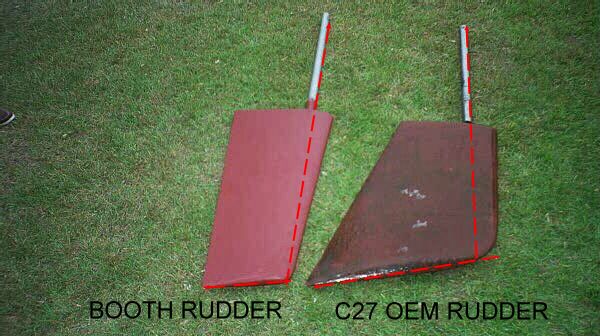
Balance: The Booth rudder has less total area in front of the rudder shaft, but also has a much shorter chord length.
Rudder draft/Aspect ratio: The Booth rudder has more draft than the OEM rudder With the shorter chord and greater depth, the Booth rudder has a much higher aspect ratio.
Planform: The leading edge of the Booth rudder is swept slightly aft, approximately 5+ degrees, compared to the rudder shaft.. This would add to the ruddershaft angle of 25-28 degrees.
Foil shape: The OEM has the greatest width at approx 50%. The booth rudder appears to have the width much further forward.
Known charactertics of the Booth C27 rudder: Fleet 8 racers have all switched to the Booth rudder. However, all of those boats are outboard models. The owners report that the boat develops less tiller tug, less "weatherhelm", and it points higher.

Wetter surface area: The wetted area of the IdaSailor rudder is approximately the same as the one sold by Booth Enterprises.
Balance: Note that the "balance" area in front of the rudder shaft is a greater percentage of total area than either the OEM rudder or the Booth rudder. The designer states that the balance area is about 25% of the total area. It is also distributed evenly from top to bottom. Thus it has proportionately more balance down low than both the Booth rudder and the OEM rudder.
Planform: The leading edge of the rudder is parallel to the rudder shaft. (The rudder shaft on the C27 is angled at approximately 26-28 degrees.
Rudder Draft/Aspect ratio: The IdaSailor rudder has a deeper draft than the OEM rudder and a much higher aspect ratio. The IdaSailor rudder draft is approximately equal to that of the Booth Rudder.
Known characteristics of the IdaSailor rudder: Not much is know about the rudder. It's a new product offering from IdaSailor. However, the company enjoys a good reputation for making retrofit rudders for many "Classic Plastics." They have significant experience making rudders for cruising sailboats. The rudders are made of one-piece HDPE blanks bonded to stainless posts. See http://www.idasailor.com
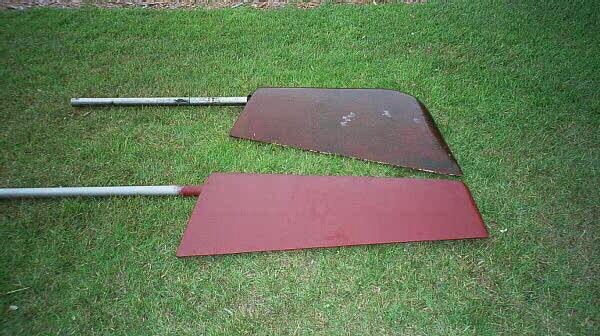
The Booth rudder is deeper then the OEM rudder.
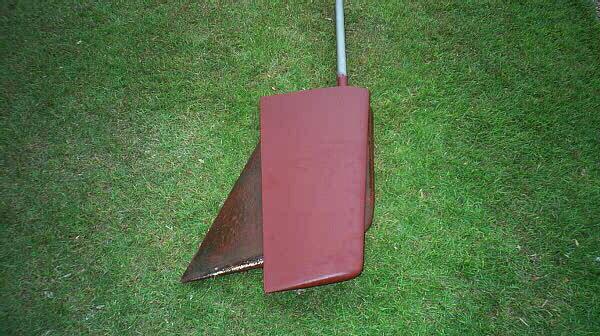
Wetted Surface area: It appears that the OEM rudder has more wetted surface area than the replacement rudder by Booth Enterprises. However, Fleet 8 in Annapolis does not impose a rating penalty for the Booth Rudder.
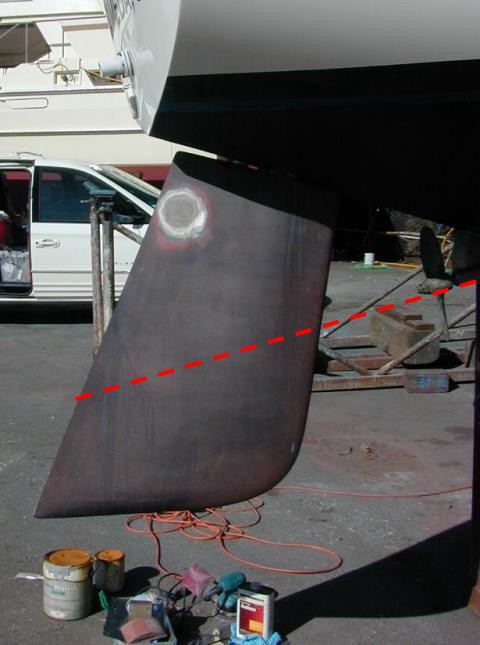
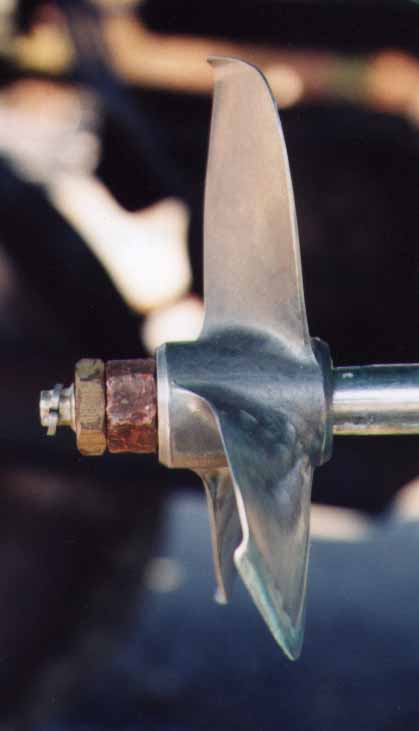
Side view of the rudder and propeller shaft (shown here with OEM 12" x 7" RH 2-blade that was on the boat when we bought it)

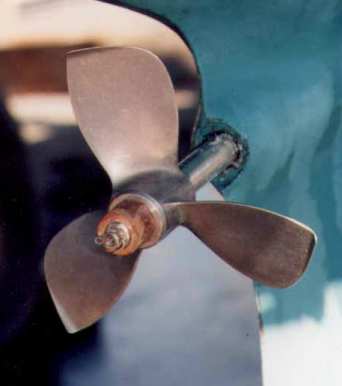
Another view of the rudder and propellor shaft. The propeller is a 10" x 7.4" RH 3 blade installed in 2003.
Indigo Propeller:
The new prop is a 3 blade design at 10" diameter and 7.4" pitch . It has winglets on the tips of the blades.
The old prop was a Michigan 12' x 7" two blade "sailboat" prop.
My observation and impressions of Indigo's 3-blade 10 x 7.4 propeller:
Pros:
- There is less prop walk in reverse with this prop.
- The boat stops more quickly in reverse.
- I don't have a tach, so I'm not sure if the engine is actually runing
at higher revs at hull speed.
- But how could the new prop cause higher engine revs than the
old prop? The old 2-blade prop had a pitch of 7"? The new 3-blade
with winglets on the tip has a pitch of 7.4".
- But how could the new prop cause higher engine revs than the
old prop? The old 2-blade prop had a pitch of 7"? The new 3-blade
with winglets on the tip has a pitch of 7.4".
Cons:
- I think the yawing problem in forward is worse with the new prop. Maybe the new prop is more efficient due to the winglets? Maybe the increase in pitch from 7 to 7.4 exacerbates the tendency to yaw?
- The boat moves too fast with the engine idling.
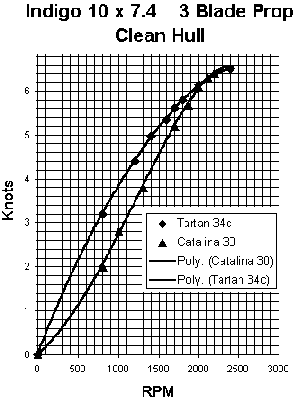
- In gear and with the throttle at an idle (approx 600 rpm), the boat moves at over 2 knots of speed in flat water and no wind. That's pretty fast -- we have to take the motor out of gear most of the time in the marina.
- If my memory is correct, the old 12 x 7 two-blade didn't push the
boat as fast at an idle.
Maybe I should have the pitch on the three blade lowered?
For more info on the new prop, see http://www.atomic4.com/propeller.html
The following is from
"The vast majority of Direct Drive Atomic 4 yachts were originally equipped with a 2 blade, 12" diameter by about 9" pitch propeller. (emphasis mine) This application allows the vessel to achieve a respectable cruise speed in calm waters at about 1400 RPM. However, wide open throttle is only about 1700 RPM which leaves very little reserve for foul weather or bottom fouling. Furthermore, at 1400 RPM, the engine is working very hard (near maximum cylinder pressure) which leads to high loads on rings, pistons, and bearings.
The design objectives of this propeller are:
- Increase cruise RPM to about 1900 with wide open throttle around 2400 RPM.
- Reduce loading on pistons, rings, and bearings by increasing RPM for a given HP.
- Increased alternator output by increasing cruise RPM.
Increase oil flow and thus pressure by increasing cruise RPM. - Increase coolant flow by increasing cruise RPM.
Prevention of Marine Growth through controlled galvanic activity. - Increasing RPM can be accomplished by simply reducing pitch on an existing 2 blade propeller but not without consequences. Most installations have less than the recommended 15% tip clearance between propeller and hull and at higher RPM, considerable noise is generated by vortices coming off the tips of the blades.
Our propeller meets all design objectives. It is a 3 blade design at 10"
diameter and 7.4" pitch . The 3 blade concept yields much less propeller
induced vibration yet total blade area is only about 8.6% greater that
the original 2 blade design and 11% less than a CDI propeller. The propeller
is investment cast of Silicon Bronze for durability, prevention of marine
growth, and accuracy of pitch and blade geometry.
The smaller diameter and blade winglets virtually eliminate the unacceptable noise associated with tip vortices generated at the higher RPM. The smaller diameter and 3 blade design also leads to a significant reduction in "prop walk" when operating in the astern direction.
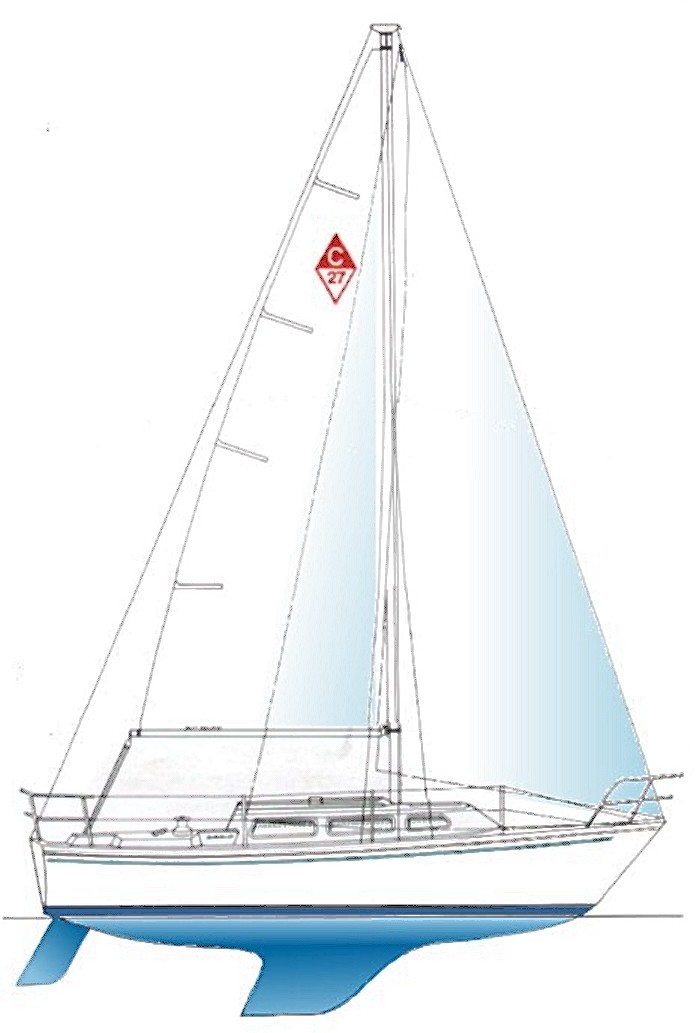
Note that the rudder appears to be swept back approximately 26-28 degrees.
The following information is gathered from the Vacanti Software website:
More modern designs keep the sweep-back angle to less than 10 or 20 degrees. Sweep back angles higher than 10-20 degrees cause decreased lift and increased drag, increasing leeway.
With more sweepback, the rudder will stall at a relatively lower smaller angle of attack. With less sweepback, the rudder maintains flow at larger angles of attack.
With aft-swept rudders, stall starts at the bottom of the foil (ignoring cavitation which might occur at the top). However, this is not an important consideration when motoring straight ahead, since the rudder is usually centered.
Graphic of the Catalina 27 underwater profile